
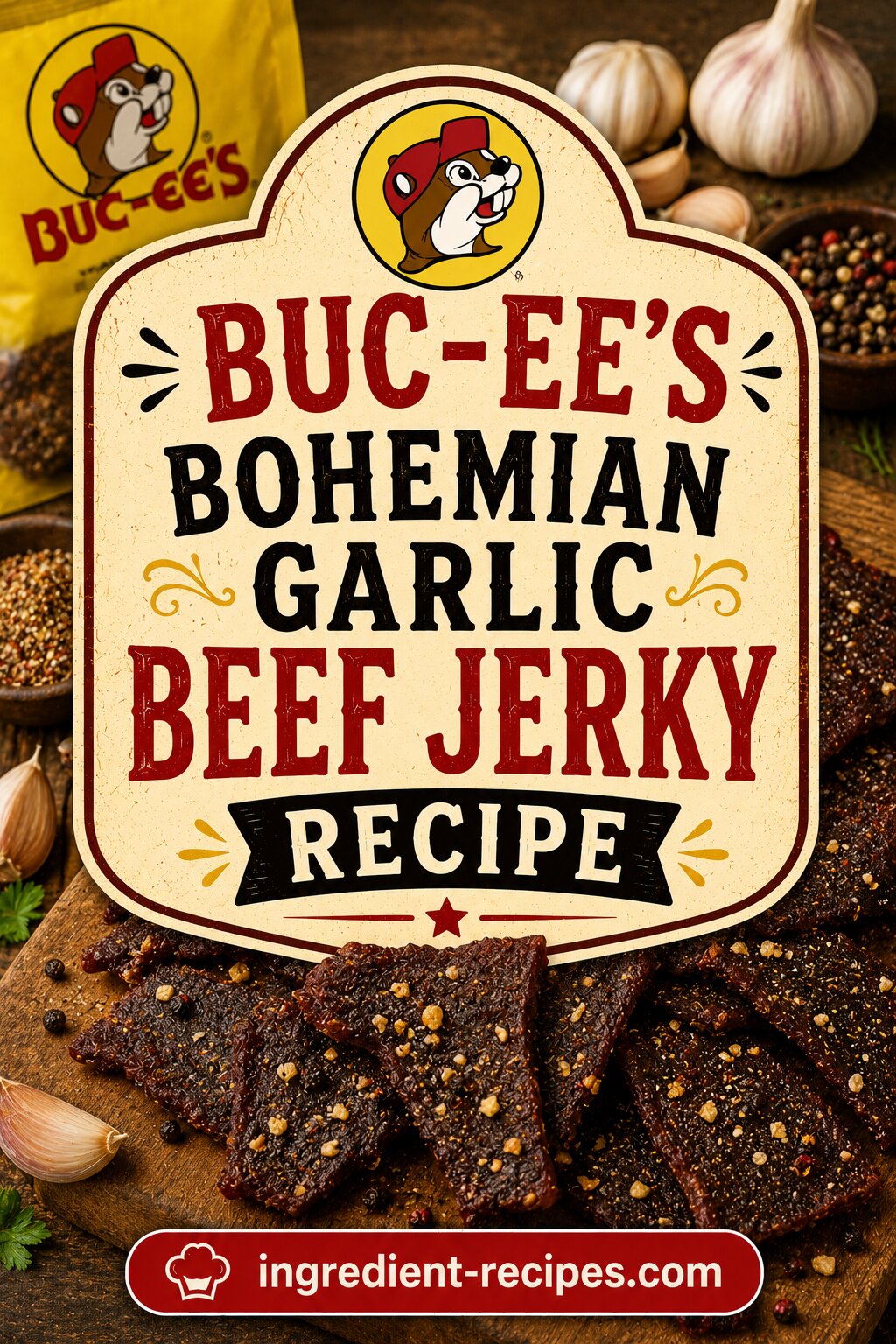
Road trippers across the American South recognize the massive glowing beaver sign of Buc-ee’s as a beacon for pristine restrooms, pristine gas pumps, and an unmatched wall of premium meat snacks. While they feature dozens of styles behind their famous jerky counter, Buc-ee’s Bohemian Garlic Beef Jerky commands a fanatical following. This specific recipe moves away from the overly sweet or intensely fiery profiles of standard jerky, delivering a savory, garlic-forward flavor profile rooted in Central Texas heritage.
The term “Bohemian” nods directly to the German and Czech immigrants who settled the Texas Hill Country, bringing traditional smokehouse techniques and a preference for garlic, black pepper, and savory cures. This copycat recipe breaks down how to choose the right lean cuts, replicate the bold garlic-and-soy brine, and dehydrate the strips to achieve that distinct, tender-yet-chewy Texas texture using an active kitchen approach.
Buc-ee’s Bohemian Garlic Beef Jerky Recipe Ingredients
The Meat Base
- 3 pounds eye of round, flank steak, or London broil (trimmed entirely of fat caps and silver skin)
The Bohemian Garlic Liquid Marinade
- 3/4 cup soy sauce (provides the primary salt and umami baseline)
- 1/2 cup water
- 1/4 cup Worcestershire sauce
- 3 tablespoons freshly minced garlic (turn this into a fine paste to maximize surface contact)
- 2 tablespoons dark brown sugar (adds just enough balance without making it sweet)
- 1 tablespoon freshly cracked coarse black pepper
- 1 teaspoon onion powder
- 1 teaspoon smoked paprika
- 1 teaspoon liquid hickory smoke (omit this if you use an outdoor wood smoker)
- 1/2 teaspoon pink curing salt Number 1 (optional, but recommended for traditional texture and color preservation)
Buc-ee’s Bohemian Garlic Beef Jerky Instructions and Steps
Step 1: Pre-Chilling and Slicing the Beef
Place your trimmed eye of round roast into the freezer for 60 to 90 minutes. You want the meat firm to the touch but not frozen solid. This chilling process stabilizes the muscle fibers, allowing you to cut uniform strips effortlessly.
Using a sharp chef’s knife or a mechanical meat slicer, cut the beef into strips measuring roughly 1/8-inch to 1/4-inch thick. Slice with the grain if you prefer the traditional, tough, and chewy Texas style that you can tear apart with your teeth. Slice across the grain if you prefer a modern, tender bite that breaks apart easily.
Step 2: Whisking the Marinade
In a large glass bowl or a multi-gallon zipper-locking bag, combine the soy sauce, water, Worcestershire sauce, minced garlic paste, dark brown sugar, coarse black pepper, onion powder, smoked paprika, liquid smoke, and pink curing salt. Whisk the mixture vigorously until the brown sugar and curing salt dissolve entirely into the liquid.
Step 3: Submerging and Curing
Add the sliced beef strips into the marinade. Use your hands to massage the liquid into every individual piece of meat, ensuring no strips stick together. Seal the bag tightly, pressing out all excess air.
Place the marinating beef into the refrigerator for at least 12 hours, though 16 to 24 hours yields a much deeper garlic infusion that mimics the authentic Buc-ee’s counter style. Flip the bag a few times during the refrigeration window to distribute the settling spices.
Step 4: Draining and Surface Prepping
Remove the beef strips from the refrigerator and drain the excess liquid marinade through a colander. Lay the strips flat in a single layer over several sheets of paper towels.
Place more paper towels on top and press firmly to remove all surface moisture. Drying the surface speeds up the dehydration process significantly and prevents the meat from steaming inside the machine.
Step 5: Dehydration Sequence
Arrange the seasoned beef strips across your dehydrator trays or oven wire racks. Ensure you leave a 1/2-inch gap between each piece so the warm air circulates freely. Do not overlap or stack the meat.
[Load Trays] ➔ Set Dehydrator to 160 F ➔ Dry 4-5 Hours ➔ Check for White Muscle Fibers
Set your food dehydrator to 160 degrees Fahrenheit (71 degrees Celsius). If you use a conventional home oven, set it to its lowest warm setting (typically 170 degrees Fahrenheit) and prop the oven door open slightly with a wooden spoon to let moisture escape. Run the drying process for 4 to 5 hours.
Step 6: Testing and Cooling
Begin checking the jerky around the 4-hour mark. Take a piece out, let it cool completely to room temperature for 5 minutes, and bend it gently. The jerky should bend easily and show white, frayed muscle fibers along the crease without snapping completely in half. If it breaks, you over-dried it; if it feels spongy or damp, slide it back in for another 30 minutes.
Essential Tips for Buc-ee’s Bohemian Garlic Beef Jerky
- Employ Fresh Garlic Over Powder: While garlic powder dissolves smoothly, it lacks the pungent, aromatic top notes that define a true Bohemian recipe. Always utilize freshly minced garlic or a garlic press to turn real cloves into a fine paste for the marinade.
- Aggressively Remove Fat: Substantial fat does not dehydrate safely, and it acts as the primary cause of premature spoilage in homemade jerky. Spend time trimming every speck of external fat and internal marbling from your raw beef before slicing.
- The Warm Water Soak: If you find the jerky too salty after drying, you can reduce the soy sauce by 1/4 cup and replace that volume with plain water in your next batch, or ensure you use low-sodium soy sauce.
Customization and Pairing Ideas
- The Spicy Bohemian: Add 1 tablespoon of crushed red pepper flakes or 1 teaspoon of cayenne pepper directly into the marinade if you prefer the “Hot and Spicy” variation found at the Texas rest stop.
- The Garlic-Parmesan Crust: Sprinkle 2 tablespoons of powdered, shelf-stable Parmesan cheese over the damp jerky strips right after blotting them dry in Step 4, immediately before they enter the dehydrator.
- Beverage Harmonizing: This intense, garlicky snack pairs exceptionally well with an ice-cold, crisp pilsner beer, a traditional Texas Shiner Bock, or a tart, un-sweetened lemonade that cuts cleanly through the rich, savory meat oils.
Storage and Reheating
- The Initial Cure Rest: Allow the finished jerky to sit uncovered on a clean countertop for 1 hour after processing to let any residual heat escape. Packing warm jerky into a bag creates condensation, which invites immediate mold growth.
- Short-Term Storage: Place the dried jerky into a clean, resealable glass jar or a zip-locking plastic bag. Store it in a cool, dark pantry for up to 1 month. If you did not use pink curing salt, consume the batch within 2 weeks or keep it in the refrigerator.
- Long-Term Preservation: For maximum shelf life, pack the jerky into vacuum-sealed bags along with a food-grade oxygen absorber packet. This setup keeps the jerky fresh and safe from oxidation for up to 6 to 12 months.
- Reheating/Softening: Jerky does not require traditional reheating, but if your batch dries out too much and turns uncomfortably tough, you can place the strips into a container with a damp piece of paper towel for 4 hours to help the meat fibers absorb a trace amount of moisture.
Alternatives, Substitutes, and Similar Dishes
- Bohemian Garlic Turkey Jerky: Swap the lean beef for skinless turkey breast strips. Turkey absorbs the garlic-soy marinade beautifully and offers a lighter, lower-fat alternative that still delivers the identical snack profile.
- Buc-ee’s Steakhouse Style: If you prefer a thicker, juicier chew over the dry Bohemian style, cut your beef strips 1/3-inch thick and replace the soy sauce with a premium steak sauce or marinade base.
- Biltong Comparison: Unlike dehydrated jerky, South African biltong uses thick steaks cured in vinegar and coriander before air-drying naturally over several days, yielding a completely different texture but a similar savory depth.
Why do I need to use water in the jerky marinade?
Water dilutes the highly concentrated sodium levels of the soy and Worcestershire sauces. Without that half-cup of water, the liquid reduces during dehydration and leaves a harsh, unpalatable salt crust on the outside of the meat.
Is pink curing salt mandatory for this recipe?
No, it is not strictly mandatory if you intend to store the jerky in your refrigerator or consume it within two weeks. However, pink curing salt Number 1 provides the authentic pinkish-red color, establishes texture, and eliminates the risk of foodborne illnesses when drying meat at low temperatures.
Can I execute this recipe inside an air fryer?
Yes, you can use an air fryer if your specific appliance features a dedicated “Dehydrate” setting that drops down to 150 or 160 degrees Fahrenheit. Do not use the standard air fry mode, as high heat will cook the meat like a steak rather than drying it out.
Why did my finished jerky develop a white powder on the surface?
If the powder appears right after storage, it is usually just salt or fat rising to the surface as the meat contracts, which is completely safe. However, if the white substance looks fuzzy, smells musty, or pulls apart like a web, it is mold, and you must discard the entire batch immediately.
Top round or bottom round work as phenomenal substitutes because they are affordable, large, and remarkably lean. Flank steak also works well, though it yields a distinctly stringy, fibrous chew that some jerky fans prefer.
Summary
The Buc-ee’s Bohemian Garlic Beef Jerky Recipe offers a savory escape from mainstream sweet jerky varieties by honoring old-world Central Texas smokehouse traditions. By marinating lean beef strips in a potent blend of fresh garlic paste, soy sauce, and aromatic spices for 24 hours, you infuse the meat with an un-compromised, savory depth. Following the precise dehydration guidelines ensures you achieve that classic, road-trip-ready chew right from your home kitchen.